Condos were once the hottest real estate in Denver and throughout the front range and now suddenly the tides have turned. Days on the market have jumped, prices are down, and sellers are now in a panic to dump properties. Is now a good time to jump into the condo market? What is causing the huge reset in prices? What price points should you avoid now? What does this mean for real estate in general?
How much have Condo prices fallen in Colorado
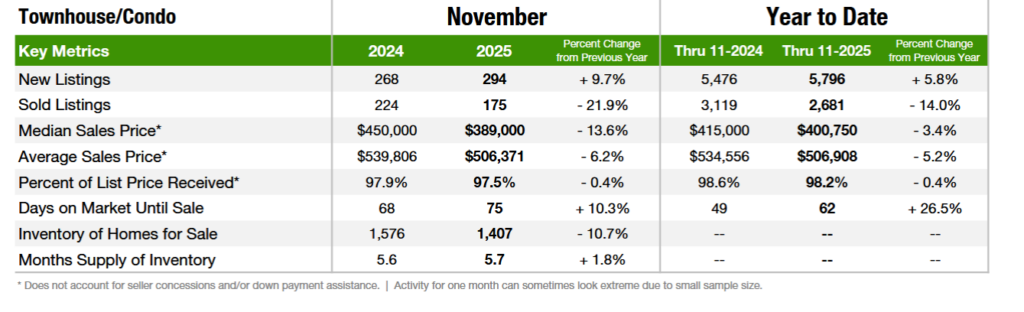
Condo and townhome sales prices are down 3.2% in Jefferson County, 4% in Douglas County, 3.4% in Denver County, and 4.9% in Arapahoe County based on the median home price year over year. Those declines aren’t dramatic, but stack it with inflation of 3%, and owners are seeing a noticeable erosion in wealth. And then there is Broomfield County and Denver county which are either an anomaly or a harbinger.
Median condo sales prices were down 12.2% in Broomfield in November compared to last year, according to the Colorado Association of Realtors. And it isn’t about a bad month. Year-to-date, the year-over-year decline is 9.6%. Listings, which took 55 days on average to find a buyer last year, took 97 days in November. Sales across the year are down by a fifth from last year.
In Denver, condo sale prices are down 13.6% in November with days on the market increasing almost 30% year over year. Furthermore inventory continues to creep up.
4 reasons for the sudden change in Denver’s condo market
The condo problem has been building for years but it has not hit a high note as you can see from the data above. Prices are down substantially throughout Denver and inventory has quickly jumped 20% well above any precovid levels. Why the sudden change of fortunes in the condo market.
- Legislation: Various new pieces of legislation which were meant to help homeowners have gone to far and put many HOAs on the fences. Now that it is substantially more expensive for HOAs to collect dues are going up and making it more expensive for everyone else.
- Insurance: Just like residential insurance, coverage on large commercial condos has gone up substantially in price along with new requirements to even get insurance. For example Insurance companies are now requiring updates to roofs, electrical, etc… in order to even get coverage. These costs are passed on to owners in the form of higher dues and special assessments.
- Huge capital calls: A huge number of condos were building in a 30 year period between 1970 and 2000 which means these buildings are due for major updates from boilers to roofs to elevators, etc…. This is leading to huge capital calls from owners in order to pay for the upgrades. Furthermore many associations have drastically underfunded their reserves leading to even higher capital calls.
- Financing: Many lenders are increasing requirements for condos including ensuring associations have full replacement cost coverage which is considerably more expensive than many condo HOAs carry today. Furthermore many lenders are requiring up to 30% down which is making it even more difficult to sell.
Long and short the capital calls, financing, and increasing HOA dues are making condos considerably more expensive to own.
What condo price points should you avoid
Lower priced condos are getting hit the hardest as the numbers no longer make sense to pay for the monthly HOA dues, capital calls, etc… At the lower price points it is now cheaper to rent which is making it increasingly more difficult to sell leading to huge increases in inventory. Furthermore as the single family market is cooling in the front range there are other single family options that end up cheaper without the monthly HOA dues.
Are falling condo prices a harbinger for the broader real estate market?
There is a theory that condo prices are a leading indicator for the direction of the broader real estate market. The theory goes that condo prices adjust earlier than single family home prices in a real estate cycle. Unfortunately, there is no concrete evidence I could find to back the theory up that condos are a predicter for the broader real estate market. If you are reading this and have concrete research that backs up the theory one way or the other, please send my way!
My gut says that the 4 factors above combined with the oversupply of higher end apartments is radically altering the condo market. In essence the substitution effect is killing the condo market. Why would someone by a 200k condo, pay insurance, maintenance, HOA dues, costs to update the unit, etc… as opposed to move into a brand new apartment at 60% of the current cost of a condo? The answer is most people will not and instead of buying the inexpensive condo, they are opting to merely rent a property for less. The substitution effect is the biggest driver coupled with uncertainty about HOA dues, special assessments, etc… that is transforming the market.
Will falling condo prices in Colorado lead to a broader real estate reset?
Although it seems like a sudden shift in the condo market, the factors driving condo prices lower have been in the making for years. The real estate market in Denver is just now waking up to the new reality with declining prices and a surge in inventory. Based on the 4 factors above and the substitution effect, we are just at the beginning of this process so I would advise anyone looking to buy a condo in Denver metro to be very cautious as values have a lot further to drop especially at the lower price points.
Fortunately, in this cycle I don’t see the recent reset in condo prices as a leading indicator for the broader real estate market.
Additional Reading/Resources:
- https://coloradohardmoney.com/new-bill-in-colorado-legislature-drastically-increases-hoa-fees/
- https://coloradorealtors.com/market-trends/regional-and-statewide-statistics/
- https://www.denverpost.com/2025/12/23/denver-broomfield-condo-market-housing/
- https://coloradohardmoney.com/big-changes-in-colorado-real-estate-every-major-market-impacted/