
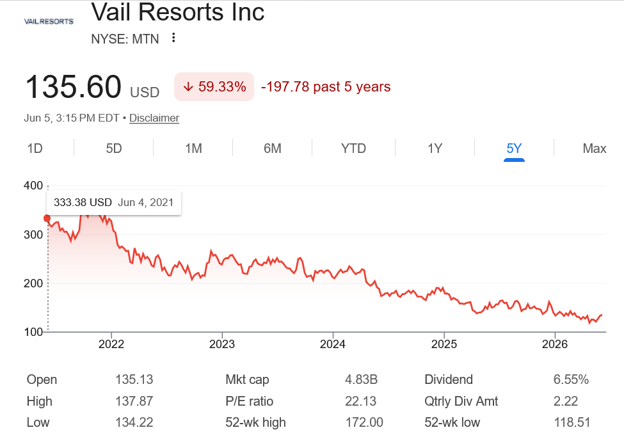
Take a look at the stock chart of Vail Resorts, which has lost almost 60% of its value in the last five years while the S&P has returned an approximately 90% gain. The vultures are circling with a Utah billionaire proposing a sale of Park City to stop the bleeding. Is this the beginning of the end for Vail resorts? What does this mean for real estate in Colorado ski towns? Why is Vail characterized as McDonalds?
What has happened to Vail Resorts in the last 5 years?
Vail resorts as grossly underperformed the overwhelming majority of companies in the S&P 500 peaking in 2022 and then falling almost every year since then. Below I’m focusing on net income, because at the end of the day who cares about revenue if costs are rising exponentially it washes out the gains in income. I’m assuming 2026 will continue the trend of declining net income as the street estimates are for around 128 million. Long and short because of Vail resorts performance, they are now on the radar as a takeover candidate.
Projected 2026: 128.0 million
Fiscal Year 2025: $280.0 million
Fiscal Year 2024: $231.1 million
Fiscal Year 2023: $265.8 million
Fiscal Year 2022: $347.9 million
Fiscal Year 2021: $127.9 million
On a side note, the objective of the Epic pass is to provide Vail with a hedge against weather so for example if Vail has a bad year, revenue from Whistler or one of their international resorts would offset the loss in one location, basically smoothing out revenue. Unfortunately, this did not work as planned. Last year was one of the worst snow years in the last 30 years in the Rockies, the Epic pass should have insulated Vail’s income instead it fell to the same level it was in 2021.
What is a billionaire proposing in Park City?
Prince, the billionaire investor in Utah who sold Cloudfare, first started urging Vail Resorts to sell Park City Mountain Resort last year and again this March in short social media bursts. He thought he would get the ski area in five years and “it was inevitable that I would get it in the next 25 years.”
“I am now increasingly convinced it’s going to happen a lot faster than that, because they’re in real trouble,” he says.
Prince says the Vail Resorts model “is like McDonald’s.”
“There’s no personality,” he says. “Vail just commodifies and dumbs down everything.”
Imagine a different model where Vail doesn’t own anything and is focused on selling Epic passes and convincing resorts they should take Epic Pass skiers, Prince says. Then resort operators and mountain communities could work together to boost their own appeal, which in turns amplifies their bargaining power with pass-selling companies like Vail Resorts and Alterra Mountain Co.
The hostile takeover of Vail resorts
Whether you agree with it or not, Wall Street is typically pretty good at allocating capital. In the case of Vail, it appears the parts (ie: the value of each of their ski resorts) are worth considerably worth more than what the market is pricing Vail’s stock price out. We have seen time and time again that this leads to a “reallocation” of capital.
Essentially Vail, due to the under-performance of their earnings, has become a target for activist investors to drastically increase value. Over the next few years (if it isn’t already happening we just haven’t heard about it) if Vail doesn’t radically increase its earning per share look for activist investors to get involved to “help” increase the return of Vail. This will most likely occur by selling off key assets like Park City to raise capital.
How could huge changes occur within the ski industry?
If Vail resorts were taken over, I would assume the first step would be to likely sell off certain resorts in order to create value for shareholders. A resort like Park City would be top of mind for a sale. This would basically unwind the huge consolidation we have seen since 1996 when Vail acquired Breckenridge, Keystone, and Arapahoe Basin. The theory for the consolidation is that scale would bring huge profits compared to free standing resorts. But with Vail’s performance it does make you wonder if they have gotten too big.
Although Aspen and Telluride are not publicly traded, I would say with very high confidence that each of these mountains is considerably more profitable than the majority of Vail’s mountains. Essentially Vail has tried to become the Walmart of the ski industry and it is challenging to be the low-price leader with the Epic pass and rely on volume in a very expensive industry.
Will Vail’s fall spell the end of the megapass?
I don’t think that the Epic Pass will go away but I do think it could change. There is a likely scenario where the all you can eat buffet is drastically limited for example you would buy a season pass to Breckenridge and then also have the Epic pass that gives you 8 days at select mountains or something along those lines. This would be similar to how the Epic pass is today in places like Telluride.
Is Alterra next to fail?
Alterra is a bit different than Vail as they are privately held so they don’t have the external pressure of a publicly traded company. With that said, Alterra could also come under pressure as they are starting to have similar issues as Vail. For example there is tension in Steamboat that has upset locals where the free parking is now being eliminated. As Alterra continues to push on expenses and revenue locals are going to revolt creating similar problems that Vail is seeing in places like Park City or Vail. Furthermore, if there is a shakeup in Vail, there could also be a similar shakeup that trickles to Alterra.
What happens to real estate in each of the Colorado ski towns?
This is an interesting question and will depend on the respective resort. Overall Vail and/or Alterra own most of the premier big mountain resorts like Breckenridge, Vail, Keystone, Crested Butte, Whistler, Park City, etc… which should insulate each of these towns from big price drops. Fortunately the resort industry has changed radically over the past 6 years. Each town is much more of a year round destination with summer visitation now catching up to winter visitation.
With that said, how real estate shakes out will depend on who ends up buying each mountain. For example in Park City if a billionaire buys it and puts substantial money into each mountain that will help the community.
Along with who buys the mountain, towns like Breckenridge will be impacted more than a town like Beaver Creek. Breckenridge was built for volume especially with the number of nightly rentals in Summit County. Whatever happens it is likely that volume will be reduced and the all you can eat buffet will come to an end. This will hurt towns like Breckenridge more than others that rely on the huge volumes.
Although the volume of skiers will likely decline, the theory is that the customers will be more profitable so there is a scenario where lower volumes actually could lead to higher revenue at each respective resort. Long and short, I don’t see a free fall in any town, but how well each town performs will be dependent on the prospective buyer, the investments put into the resort and if the reduction in volume of skiers actually increases income for each resort.
Don’t underestimate the huge changes coming to the ski industry
I would put my probability around 60% that something will happen drastically with Vail. This past season is a prime example that the mega model does not work as described. Even with the poor snow year, the megapass should have been able to smooth out the income declines, but instead income plummeted to 2021 levels. Furthermore, initial indications show pass sales down around 10% for next year.
It does not take a phd to see the model is not working and someone will act to provide shareholder value from Vail’s resort assets. Either there will be new management that drastically shakes up the current trajectory or there will be a hostile bid to increase the value of Vail Resorts. Either of these scenarios will lead to big changes including the possible sales of resorts.
Breaking up or radically altering the current model will be the biggest change in the last 30 years and will have far reaching effects across every resort market. Real estate will be impacted depending on the location, the buyer, and how each resort performs independently. We will need to watch how it all shakes out, but based on the past five years changes are underfoot, the million-dollar question is when and how radical the changes will be.
Additional Reading/Resources:
- https://coloradosun.com/2026/06/05/matthew-prince-park-city-vail-resorts/
- https://www.wsj.com/business/earnings/vail-resorts-cuts-outlook-again-as-weather-weighs-on-visits-9b92cb86?mod=mhp
- https://www.fairviewlending.com/what-is-the-best-ski-town-investment/
- https://coloradohardmoney.com/2025-best-colorado-ski-real-estate/
We are a Colorado Private/ Hard Money Lender funding in cash!
If you were forwarded this message, please subscribe to our newsletter
I need your help as my goal in writing these articles is to provide the best information/insight on Colorado Real Estate that you cannot get anywhere else! Please like and share my articles on linked in, twitter, facebook, and other social media and forward to your friends/associates 😊 I would greatly appreciate it.
Glen Weinberg personally writes these weekly real estate blogs based on his real estate experience as a lender and property owner. He is the owner of Fairview Commercial Lending. Glen has been published as an expert in hard money lending, real estate valuation, financing, and various other real estate topics in Bloomberg, Businessweek ,the Colorado Real Estate Journal, National Association of Realtors Magazine, The Real Deal real estate news, the CO Biz Magazine, The Denver Post, The Scotsman mortgage broker guide, Mortgage Professional America and various other national publications.
Glen resides in Colorado, lends in Colorado, owns property in Colorado, and services loans in Colorado which provides a unique real estate prospective of what is actually happening on the ground both in Denver and throughout Colorado. My goal of this real estate blog is to provide an honest assessment of what I see happening in Colorado real estate and how it will impact real estate owners, buyers, realtors, mortgage professionals, etc…
Fairview is the recognized leader in Colorado Hard Money and Colorado private lending focusing on residential investment properties and commercial properties both in Denver and throughout the state. We are the Colorado experts having closed thousands of loans throughout the Front range, Western slope, resort communities, and everywhere in between. We also live, work, and play in the mountains throughout Colorado and understand the intricacies of each market.
When you call you will speak directly to the decision makers and get an honest answer quickly. We are recognized in the industry as the leader in Colorado hard money lending with no upfront fees or any other games. Learn more about Hard Money Lending through our free Hard Money Guide. To get started on a loan all we need is our simple one page application (no upfront fees or other games). Learn how to find a reputable hard money lender and why Fairview is the best hard money lender for investors.
Tags: Denver hard money, Denver Colorado hard money lender, Colorado hard money, Colorado private lender, Denver private lender, Colorado ski lender, Colorado real estate trends, Colorado real estate prices, Private real estate loans, Hard money loans, Private real estate mortgage, Hard money mortgage lender, Hard money mortgage lender, residential hard money loans, commercial hard money loans, private mortgage lender, Hard Money Lender, Private lender, private real estate lender, residential hard money lender, commercial hard money lender, No doc real estate lender



