
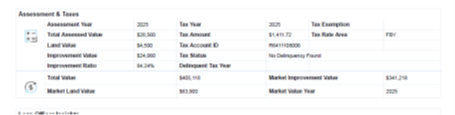
Throughout the state of Colorado property owners are paying substantially more in taxes than they should due to one fundamental flaw in the assessment. Here is a recent example: I was asked to evaluate a property in CO springs for a loan. The purchase price was 275k, and yet the assessed value was 405k, meaning the assessment rate was 32% higher than it should be and the owner was paying 32% more in property taxes for years. Why is there a disconnect in assessed value when property values have basically been flat/declining the last 3 years? See the chart below, how is this issue even possible?

Fundamental flaw in how values in Colorado are assessed
During the crazy price increases of Covid, the assessors made one fundamental flaw that is leading to overvalued properties throughout the state. I only found this out when I did an appeal of my property taxes and my appeal was rejected.
What happened on my Colorado property tax appeal?
I was floored to get the letter in the mail saying that my value was not changing at all. I had three valid comps that showed my property was overvalued by a substantial amount (25%). I spoke with the assessor about my concerns, but he didn’t seem to care.
There was another house that was nicer than mine that was two doors down sold one month after the assessment period for 30% less than what the assessment said the value was. Even though this is not a valid sale, it further proved that the assessor was way too aggressive on their valuation.
The assessor had his thoughts on what the value should be regardless of any data I presented but I was still surprised to not get any relief on my assessment even after I pointed out a fundamental flaw in their reasoning. This is the first time I have ever done an appeal and not received a substantial reduction. Fortunately I was able to “appeal” their rejection of my appeal to the board of assessors.
What fundamental flaw am I seeing with Colorado assessor’s data?
There is a fundamental flaw in the assessor reasoning. With such a fast-moving market over the last several years in many parts of Colorado, appreciation was off the charts. Any property that was sold during the assessment period had to be brought to 6/30/22. For example, if a house sold on 1/1/22 the assessor would have to adjust the sales price based on annual appreciation. In the case of my property, the assessor calculated that houses were appreciated at 3.2%/ month, so in the example above if a house sold for 1 million on 1/1/22, the adjusted sales price would be (19.2% higher 6 time 3.2%) leading to an adjusted value of 1, 192,000 to use as a comparable.
This begs the question, should the assessor use actual sales or “predicted values” when looking at a property. Unfortunately, throughout the state assessors began bringing sales to current value for reassessment purposes adding substantial to properties. As we can see from the example above, the value used is almost 20% higher than what the property actually sold for.
This bringing of sales forward based on appreciation rate leads to inflated values. In my case, I found a house two doors down that sold one month after the assessment period (July as opposed to June) and it sold for 30% less than what it was assessed for which means that the bringing forward of sales was inflating values
How did my Colorado property tax appeal get resolved
When I brought the above argument to the assessor, they immediately dismissed my concern and so I scheduled a meeting with the board of assessors so that they would hear my case. I was pretty convinced that my reasoning was sound and that my value was about 30% higher than what it should be. My goal was to take my case all the way to the board of equalization to help everyone else in Colorado and stop this practice of overinflating house values.
Ironically a week or so before the board of assessors meeting the county assessor reduced my value to within about 5% of what I thought it should be so I no longer had a case to dispute.
Inflated assessed values throughout the state of Colorado
In my experience I have seen assessed values way off in some cases as much as 60% due to the valuation method that assessors used to bring sales forward as opposed to just using actual sales comparables. This is especially prevalent throughout the front range where values have essentially stalled.
Why should you care about the tax assessor inflating your property tax value?
I hear this all the time, don’t you want your assessed value to be high, so it shows your house is more valuable? Unfortunately, this reasoning is seriously flawed, the assessment has nothing to do with what you can sell a property for. It is only used for tax purposes to show home much you should pay for property taxes.
The higher the assessed value, the more you pay in property taxes. In the illustration above in CO Springs, the owner has been paying 32% more in property taxes than they should for the last 4 years. This is a huge number. Assuming the annual property tax bill is 2500, this means the owner is paying an extra 600 a year in taxes over 5 years, the owner has paid an extra 3k in property taxes that they shouldn’t be paying due to the overvaluation.
Inflated assessed values worse in attached units especially in the front range
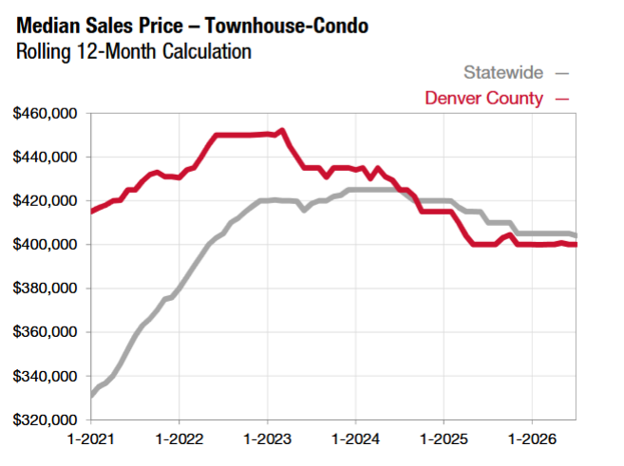
Look at the chart of condos/townhomes, values have fallen substantially especially in the metro area. Even though the chart shows a leveling off of price, my gut says that there is more downside yet to come on condos whenever the economy slows down further. You should see assessed values reset substantially in the condo market. On a side note, I recently saw a condo in Denver that sold for 55% less than the assessed value.

In General Denver and Front range have largest inflated assessed value
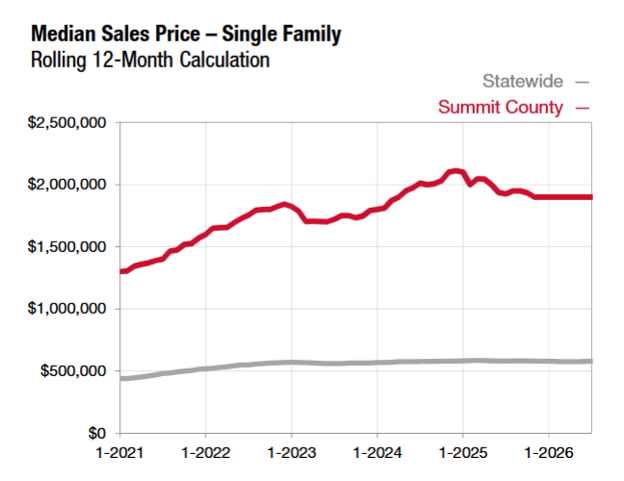
As you can see from the chart, Denver is clearly off its highs and depending on the data you use, Denver single family values are slightly decreasing albeit not like the change from the peak in 2022 with a significant decline. This has led to a huge disconnect between assessed values and market values. Unfortunately the assessor is quick to raise assessed values but very slow to drop them but 2027 will mark a huge change as during the assessment period prices for the most part declined.

Most Colorado mountain towns are not over assessed as much
Look at the chart above of Routt County, home to Steamboat, even during the last reassessment cycle values continued to increase which has allowed actual values to catch up with predicted values. The same is occurring in most mountain towns with one caveat. Ski towns like Breckenridge have basically flatlined on appreciation so I have seen a number of properties in Breckenridge overvalued by 20% or so.
2027 year of reckoning on overinflation of assessed values in Colorado
It is not surprising that the assessor is quick to raise values and use predicted appreciation to further increase values but is very slow to adjust values down. In the case above, I commonly see assessors using future appreciation to “bring sales forward” (in other words make sales look higher than they are to increase valuation), but I have never seen the inverse occur. For example, look at the chart above of Denver condo/townhomes, based on this information, there should be a factor uses by the assessor for depreciation, for example if a sale in the same complex sold 18 months ago and values have declined 10% then that sale price should be reduced just like it was increased during quickly appreciating times by the assessor.
2027 will bring the party to a close for the overinflated values. Remember properties are assessed in every odd year. For the upcoming 2027 reappraisal year in Colorado, county assessors will use comparable market sales (comps) from a 24-month base study period starting July 1, 2024, and ending June 30, 2026. Any sales transactions that occurred after June 30, 2026, generally cannot be considered for the base 2027 valuation.
Look at the Zillow market report chart above of Denver, there was a clear decline from 7/1/24 until 6/30/26 of approximately 10% which means assessed values overall should decline around 10% in Denver.
Summary: you are paying way more in property taxes than you should
Even though 2027 is the year of reckoning, your relief might not be automatic meaning that you will need to do an appeal next summer to see the decline in your values. Remember the assessors only use predicted values to increase your assessed value by including and appreciation rate on closed sales while on the flip side they have never done the inverse using a depreciation rate to reduce actual closed sales.
The crazy part is that inflated assessed values is a very easy fix. Require assessors to use only closed sales while disallowing a change in the sales price due to the age of the sale. There are enough transactions, especially in metro areas, to find ample sales without making adjustments to the sales price. This easy fix would eliminate this huge over valuation of properties throughout the state. Unfortunately, although the fix is easy, I’m certain the Colorado legislature would even consider a measure to accurately assess properties as it would lead to less tax revenue.
Remember the 2027 reassessment is a huge inflection point in Colorado Assessed values, but a reduction is not given, you likely will need to appeal your assessed value. Long and short, also remember that assessed value is not market value when you are looking to buy or sell a property. Assessed value should be the value at a point in time based on the actual sales from the prior two years.
I put together a guide on how to appeal your Colorado property taxes and win.
Additional Reading/Resources
- https://coloradohardmoney.com/category/colorado-property-taxes/
- https://coloradohardmoney.com/why-are-colorado-property-taxes-rising/
- https://coloradohardmoney.com/colorado-property-taxes-jump-40-percent/
- https://coloradohardmoney.com/guide-to-appeal-colorado-property-taxes-and-win/
We are a Private/ Hard Money Lender funding in cash!
If you were forwarded this message, please subscribe to our newsletter
Glen Weinberg personally writes these weekly real estate blogs based on his real estate experience as a lender and property owner. I’m not an armchair reporter/writer. We are an actual private lender, lending our own money. We service our own loans and own commercial and residential real estate throughout the country.
My day job is and continues to be private real estate lending/ hard money lending which enables me to have a unique perspective on the market. I don’t accept any paid sponsorships or ads on my blog to ensure accurate information. I’ve been writing this for almost 20 years and have over 30k subscribers. Please like and share my blogs on linkedin, twitter, facebook, and other social media and forward to your friends 😊. I would greatly appreciate it.
Fairview is a hard money lender specializing in private money loans / non-bank real estate loans in Georgia, Colorado, and Florida. We are recognized in the industry as the leader in hard money lending/ Private Lending with no upfront fees or any other games. We fund our own loans and provide honest answers quickly. Learn more about Hard Money Lending through our free Hard Money Guide. To get started on a loan all we need is our simple one page application (no upfront fees or other games). Learn how to find a reputable hard money lender and why Fairview is the best hard money lender for investors.
Written by Glen Weinberg, COO/ VP Fairview Commercial Lending. Glen has been published as an expert in hard money lending, real estate valuation, financing, and various other real estate topics in Bloomberg, Businessweek ,the Colorado Real Estate Journal, National Association of Realtors Magazine, The Real Deal real estate news, the CO Biz Magazine, The Denver Post, The Scotsman mortgage broker guide, Mortgage Professional America and various other national publications.
Tags: Hard Money Lender, Private lender, Denver hard money, Georgia hard money, Colorado hard money, Atlanta hard money, Florida hard money, Colorado private lender, Georgia private lender, Private real estate loans, Hard money loans, Private real estate mortgage, Hard money mortgage lender, residential hard money loans, commercial hard money loans, private mortgage lender, private real estate lender, residential hard money lender, commercial hard money lender, No doc real estate lender



