
Our legislature recently enacted a new law that will impact large property owners starting this year. Who is impacted by the “Decarbonization law” Who will be paying millions for building upgrades (hint not the government)? Who will be on the hook for fines up to 47k/day? What does this new law mean for commercial real estate throughout the entire state of Colorado? Why is a property in Steamboat treated the same as a property in Denver? Should you ever buy/invest in a property over 50k feet in Colorado?
What is the new Colorado Decarbonization law?
The new bill, HB 25-1269 which was signed into law essentially put a huge onus of “climate action” on large property owners to substantially reduce their energy use by 30% in less than 5 years. There is no funding for business owners to pay for the upgrades, merely a government support agency that will provide some answers for whatever that is worth and building owners will be required to pay a new fee annually to fund this new agency. BTW, this entity is useless as they did not respond to basic inquiries I made in a timely manner.
Long and short large building owners will be on the hook for millions of dollars in upgrades that will be difficult if not impossible to collect from tenants while at the same time having a very poor return on investment for owner/users.
What is a covered building under the Decarbonization law?
Covered buildings are any buildings (other than government buildings) over 50k feet. This could be an apartment building, warehouse, hospital, affordable housing project in the mountains, etc… It does not matter where the building is located for example Telluride has the same standards for reduction as Denver. The only exclusion is for buildings owned by the government so an affordable housing project in Breckenridge, if not owned by the government which most are not, would have the same requirements of energy reduction as a warehouse by DIA.
What are the new energy standards of all large properties in Colorado?
Owners of covered buildings must meet energy performance standards by 2040, with specific reduction goals for 2026 and 2030.
- Buildings must submit 2019 benchmarking data by January 1, 2026.
- Achieve a 13% energy use reduction by 2026 compared to 2019.
- Achieve a 29% energy use reduction by 2030 compared to 2019.
What are the penalties for not meeting the new Colorado green building requirements?
For Buildings that don’t meet the goals the law established fines that could be as high as $47,500 a day by 2030 and offered help only through a proposed new enterprise into which building owners must pay $400 each year for support.
What does the real estate industry think about the new Colorado Energy Efficiency law?
The biggest concerns, however, came from the Colorado Real Estate Alliance, a coalition of 15 organizations from general business groups like Colorado Concern to construction groups like Associated General Contractors to the Colorado Building Owners and Managers Association. While the group didn’t ask for rejection of the proposal, it did request adoption of a more lenient alternative proposal from the city of Denver and the addition of more compliance pathways and resource help for building owners.
Costs of compliance will be extremely significant — an average hospital must spend $45 million to hit the new targets, according to a report — during a time when the real estate industry is in “turmoil” from office vacancies and depressed property values, said Tyler Carlson, CEO of Evergreen Development. Those building owners who can get the financing to make major improvements won’t be able to recover the investment from rental or industrial tenants who are on long-term leases, meaning that the burden of costs will fall on building owners and on the tenants with the shortest-term leases — apartment renters, Carlson said.
Numbers don’t lie and the Decarbonization law will cost building owners billions
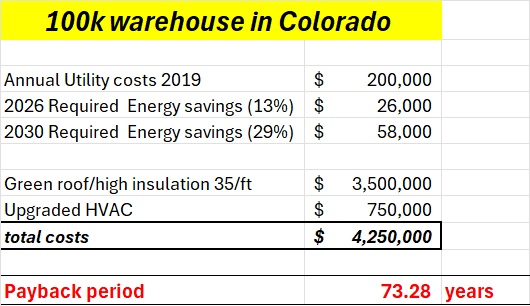
I did a quick scenario of a 100k foot warehouse in Colorado. Assume this is a distribution warehouse basically with block/tilt up concrete walls, high ceilings, dock doors, etc… A typical warehouse. To hit the energy standards for a building this size there are basically three ways
- Lighting: most newer/large warehouses have already gone to LED lighting so not much more to gain in this area
- Roof: a standard roof is around 12/ft, a green roof with lots of insulation to reduce utility costs is around 35-50/ft
- HVAC: Most large warehouses use hanging heaters for heat (super inexpensive and efficient, these would all have to be replaced with some sort of a heat pump which is super expensive to retrofit for a large warehouse
Long and short it is not cheap to get a 30% building efficiency when low hanging fruit like LED lighting has already been utilized. Based on the analysis, best case scenario would be a 75-year payback period for the upgrades, assuming it was an owner user building.
Note, if the building is leased, the tenant would not pay for this as most have long term leases (10 years or so with options on large warehouses) and they would get the utility savings while the building owner is on the hook for 4.25m.
Best case of a leased warehouse, what about an office building in Denver
There are tons of zombie office buildings in Denver that can barely keep the lights on, some can’t even make enough to cover property taxes due to high vacancies. There is no way office owners can and would be willing to invest huge sums in a property that is barely breaking even like a class C office building downtown. You will see many owners simply walking from the property as this law pushes them over the edge with no way to make a return on the property anytime soon.
Who will be the winners and losers from the new Colorado Energy efficiency law
Colorado will lose big time with larger corporations looking for large spaces will look elsewhere. Furthermore, the downtown core that is already hit hard from the office meltdown will not come back anytime soon.
Colorado’s neighbors will be huge winners. Cheyenne, WY, Salt Lake City, UT, and Kansas City, KS will eat Colorado’s lunch. Companies who want/need a presence in the intermountain west will flock to our neighbors as it will be substantially cheaper to operate in these areas.
Decarbonization law is bad for Colorado Businesses
Remember this new law applies throughout the state, think of the hospital in Leadville or other smaller rural areas that will have to spend millions on upgrades that could be used for patient care and keeping the lights on. Furthermore an affordable housing project in Steamboat that is over 50k feet will also be impacted as it is not owned by a government entity. Based on how the law is written it is very obvious that the people who wrote the bill have never owned or operated a large commercial property. On a side note apartment renters will suffer big time as the huge expenses will be passed through via higher rents as most leases are yearly as opposed to a large warehouse where they could be a 10 year lease.
The pain from this bill will be far and wide with many companies opting for other locations. Property owners are going to be left holding the bag with billions in updates required with very minimal payback (if any) over an extremely long period of time in a best-case scenario. How this law is written I would avoid owning/investing in any property in Colorado over 50k feet as the costs for upgrades will far outweigh your return.
Once again, the legislature is putting all the costs of social programs on private property owners without compensation. To make the law fair, property owners should be able to deduct anything spent on the laws compliance from their property taxes, a simple change like this would quickly level the playing field. Unfortunately, I doubt our legislature would focus on being fair to property owners. As a result, look for companies to relocate to more favorable areas and existing building owners either walking from their properties (like an older office property in Denver) or radically raising the rents for future tenants (an apartment building). Either way, it will not be good for Colorado, and the costs far outweigh any benefits.
On a side note, I had requested additional information from the supposed help desk for this new initiative building.performance@state.co.us, I wouldn’t hold your breath they are going to provide any value, in two weeks I have never received a response to basic clarifying questions on the new bill, our state government once again hard at work :<
Additional Reading/Resources
- https://energyoffice.colorado.gov/building-decarbonization-enterprise-fund#:~:text=Covered%20buildings%20under%20Building%20Performance%20Colorado%20must,as%20calculated%20by%20the%20Department%20of%20Revenue
- https://leg.colorado.gov/sites/default/files/2025a_1269_signed.pdf
- https://coloradohardmoney.com/are-politics-leading-to-lower-denver-house-prices/
- https://coloradohardmoney.com/colorado-habitability-bill-impact-on-owners/
- https://coloradohardmoney.com/colorado-property-taxes-jump-40-percent/
- https://www.altenergymag.com/article/2019/07/what-is-the-average-utility-cost-per-square-foot-of-commercial-property/31382
We are a Colorado Private/ Hard Money Lender funding in cash!
If you were forwarded this message, please subscribe to our newsletter
I need your help as my goal in writing these articles is to provide the best information/insight on Colorado Real Estate that you cannot get anywhere else! Please like and share my articles on linked in, twitter, facebook, and other social media and forward to your friends/associates I would greatly appreciate it.
Glen Weinberg personally writes these weekly real estate blogs based on his real estate experience as a lender and property owner. He is the owner of Fairview Commercial Lending. Glen has been published as an expert in hard money lending, real estate valuation, financing, and various other real estate topics in Bloomberg, Businessweek ,the Colorado Real Estate Journal, National Association of Realtors Magazine, The Real Deal real estate news, the CO Biz Magazine, The Denver Post, The Scotsman mortgage broker guide, Mortgage Professional America and various other national publications.
Glen resides in Colorado, lends in Colorado, owns property in Colorado, and services loans in Colorado which provides a unique real estate prospective of what is actually happening on the ground both in Denver and throughout Colorado. My goal of this real estate blog is to provide an honest assessment of what I see happening in Colorado real estate and how it will impact real estate owners, buyers, realtors, mortgage professionals, etc…
Fairview is the recognized leader in Colorado Hard Money and Colorado private lending focusing on residential investment properties and commercial properties both in Denver and throughout the state. We are the Colorado experts having closed thousands of loans throughout the Front range, Western slope, resort communities, and everywhere in between. We also live, work, and play in the mountains throughout Colorado and understand the intricacies of each market.
When you call you will speak directly to the decision makers and get an honest answer quickly. We are recognized in the industry as the leader in Colorado hard money lending with no upfront fees or any other games. Learn more about Hard Money Lending through our free Hard Money Guide. To get started on a loan all we need is our simple one page application (no upfront fees or other games)
Tags: Denver hard money, Denver Colorado hard money lender, Colorado hard money, Colorado private lender, Denver private lender, Colorado ski lender, Colorado real estate trends, Colorado real estate prices, Private real estate loans, Hard money loans, Private real estate mortgage, Hard money mortgage lender, Hard money mortgage lender, residential hard money loans, commercial hard money loans, private mortgage lender, Hard Money Lender, Private lender, private real estate lender, residential hard money lender, commercial hard money lender, No doc real estate lender