
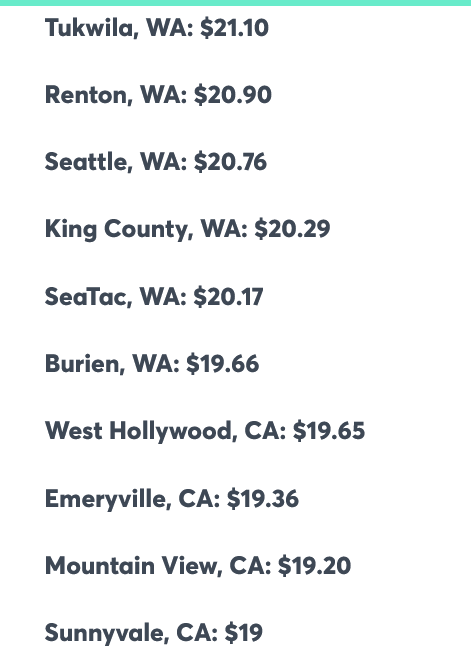
As part of an ordinance passed by Denver City Council in 2019 to get the city’s lowest earners to a better wage and then link annual pay raises to the Consumer Price Index starting in 2023, Denver’s min wage has jumped 70% in the last 6 years. This has put Denver in the top 9 highest minimum wages in the country. What is the result of the jumps in Minimum wage on affordable housing? How will real estate be impacted? What can Denver learn from other cities?
What is changing with Minimum wage in Denver this year?
Denver city officials announced earlier this month that the city’s minimum wage would rise to $19.29 per hour in 2026. Wages for tipped workers (those who make at least $3.02 per hour in tips) are set to increase to 16.27 per hour.
But looked at cumulatively, Denver’s hourly minimum wage will be $7.71 higher on Jan. 1, 2025, than it was in 2019. That’s a rise of nearly 70% in six years.
What has allowed Denver’s min wage to go up so fast/high?
With the passage of Amendment 70 in 2019, now Colorado’s minimum wage law allows cities to set their own minimum wage above the states minimum; how will this impact the Colorado economy and real estate? What does a new federal reserve study imply about the impact of wage increases?
What is the grand experiment that occurred in Seattle with a higher minimum wage?
Denver is just starting to get on the west coast “progressive” bandwagon, so it is important to see how these policies have worked out in other cities. Seattle was one of the leaders in rapidly raising the min wage. It is important to see what the data shows about Seattle’s “grand experiment” on whether raising the minimum wage to a “living wage” will actually increase the take home pay of workers.
Why should we care about Seattle in Colorado? The reason I emphasize “grand experiment” is because there have not been large increases in the minimum wage like the ones being implemented in Seattle, California, and Colorado and therefore the true impact is very debatable with hundreds of studies on both sides of the argument. One camp professes that increasing the minimum wage will increase the take home pay of employees and therefore lead to more spending, etc…. On the other side of the argument, economists feel that increased wages will have negligible impact because businesses will adapt and cut back hours, hire fewer employees, use technology to replace workers, etc…
Can both groups of economists be correct? Even though I’m a finance guy and like answers to be a clear yes or no, in this case Seattle proves that neither economic camp is totally correct all the time. Seattle’s minimum living wage increase is set to go in steps like Colorado. This “step” function has provided interesting economic modeling and helped determine when each economic theory is correct.
In Seattle, as wages increased from $9.47 to $11/ hour, the effects on earnings were pretty small, on average employees received about $288 more per year while at the same time employment declined slightly. Basically, the first increase in the minimum wage ended up a draw for economists with no clear winner since wages increased a little and employment fell a little basically canceling each other out.
A new study (same parameters used as in the first one mentioned above) just released by the University of Washington (contracted by the city of Seattle) has livened the debate about minimum wage. In their recent study, they found that as the minimum wage increased from 11 to 13/hour workers lost about 1500/year; this amounted to a $100 million a year loss in payroll. (source: UW.edu) How is this possible? This study found huge effects: For every 1 percent increase in their hourly wage, low-wage workers saw a 3 percent reduction in the number of hours worked. (source Bloomberg).
What this study tells us is that there is a “tipping point” for businesses on their ability to absorb large labor cost increases. Increasing the min wage small amounts have little impact on businesses and employees, but once this tipping point was crossed businesses adapted by increasing efficiency or reducing service. Both resulted in less labor employment. This trend will likely accelerate as wages increase in Denver to almost $20 dollars per hour as businesses will not be able to absorb or pass on the large increase to consumers.
This study was not what voters of increased minimum living wage had hoped for. With the new information coming out of Seattle what does this mean for Colorado with our min wage on track to increase drastically over the next three years?
In 2016, Colorado’s minimum wage was $8.31 and is set to increase to $12 by 2020 with Denver proposing an increase to 15.87 an almost 200% increase. In 2025 min wages are set to jump again to almost 20/hour (19.29) . What the University of Washington study showed is that the increase in the minimum wage in Seattle exceeded the “tipping point” and therefore the impact of the minimum wage was detrimental to workers. Seattle increased their minimum wage by 37% (9.47 to 13 for the study) which exceeded the tipping point for businesses.
Denver’s 70% increase in min wage will no doubt increase wages well beyond the tipping point where they are able to absorb the cost (or pass on to consumers) and therefore, similar to Seattle, low wage workers will see a net decrease in pay as hours are cut.
Impact of huge jumps in min wage on residential real estate?
Many feel that by passing min wage laws this will increase housing affordability as workers are paid more. Unfortunately, this does not occur in practice as many studies have shown that a substantial increase in Denver’s min wage will ultimately decrease the take home pay of low wage workers as hours are decreased and alternatives are utilized (automation, etc..). This decrease in pay will transfer into a deepening of the housing crisis plaguing large parts of the state as workers have less income to spend on housing.
The sharp increase in minimum wage in Denver will also increase the cost of building. As workers in lower skilled professions are now making 18 and hour, higher skilled professions will require even more as well further driving up building costs. Essentially as the lower pay scales are increased a corresponding increase in other pay scales will occur. For example why would an apprentice plumber be making anywhere close to someone taking an order at a fast food restaurant? These workers will demand more pay as well. Remember, labor is one of the biggest inputs in building so these costs must be passed on to buyers in the form of higher prices.
Denver, CO Min wage increases impact on
commercial real estate
Commercial real estate will be impacted by local min wage laws. Let’s assume a company was developing a distribution center, would the business want to pay more in wages in Denver vs Aurora? Or in Colorado vs. Utah or Wyoming? Likely not! Once the new law is fully implemented and local cities raise their min wage as we are seeing now, property owners that utilize lower paid workers (warehouse, industrial, service industries, etc.. )will migrate to lower cost areas or automate. Furthermore businesses that are labor intensive and location specific like a restaurant will either have to increase prices substantially or ultimately go out of business as margins are compressed.
Further affordable housing crisis
One of the primary reasons for the affordable housing crisis in Colorado is the huge jump in cost of living. Unfortunately large jumps in labor costs will be passed on to everyone with lower income workers bearing the brunt as a higher percentage of their income is spent on necessities. Here is what the Denver Chamber said: “Mandatory minimum wages tied to formulas like CPI will cause businesses to increase prices to meet new wage demands. Increased prices will simply continue to fuel inflation. At its worst, increased prices lead to a general increase in cost of living that might be so high as to negate any advantage gained by workers having slightly higher wages,”
In real life we have seen this play out first hand in Denver. Affordable housing issues have compounded over the last 6 years in light of min wage increases of almost 60%. This is not a random occurrence. Exactly what every mainstream economist has predicted is playing out in Denver.
Businesses will adapt to higher minimum wages in Colorado
As wages continue to increase, businesses adapt to limit the amount of labor. I’m already seeing this take place in Denver. I was at a King Soopers last week and almost all lanes were now “self checkout”. There was one cashier for 8 lanes. Labor was substantially reduced, and throughput was increased as there were more lanes with only a few cashiers up front. Other companies have also adapted like McDonalds where you order at a Kiosk greatly decreasing the number of cashiers.
The Federal reserve bank of San Francisco recently released a report stating: “Businesses have more options to automate hard-to-fill positions now than in the past,” wrote Leduc and Liu. “With rapid advances in robotics and artificial intelligence, robots can perform more jobs and tasks that required human skills only a few years ago.” In the coming age of artificial intelligence, businesses in Denver will have more choices to replace headcount and no doubt will adapt quickly with a rise to almost 20 an hour in such a short period of time.
Summary of min wage impact on Denver, Colorado real estate
The original intent of a minimum wage increase in Colorado was to ensure base workers were paid a fair living wage. The recent study of Seattle’s “grand experiment” shows that there are economic byproducts of large increases in minimum wage. The large pay increases promised at the ballot box ironically are morphing into pay decreases for the majority of workers as hours are cut and employees are eliminated due to automation. Furthermore, the huge jumps in Minimum wage are driving up wages further in the building trades leading to even more expensive housing.
The irony is that the 60% increase in the minimum wage has actually done the opposite and created an affordable housing crisis. Denver’s “Grand Experiment” is undoubtedly not so grand to workers that are now unemployed sue to the substitution effect and big jumps in minimum wage will further the affordable housing crisis that Denver is experiencing.
Additional Reading/Resources:
- https://coloradohardmoney.com/colorado-passes-new-min-wage-law-impact-on-you-and-real-estate-will-the-experiment-work-what-about-the-bear/
- https://www.denverpost.com/2025/12/29/denver-minimum-wage-increase-2026/
- https://www.denverpost.com/2024/09/01/denver-minimum-wage-small-businesses-restaurants-impact/
- https://commonsenseinstituteco.org/metro-denver-homelessness-2023/
- https://coloradosun.com/2022/08/16/minimum-wage-increase-denver-colorado-restaurants/
- https://www.bloomberg.com/news/articles/2019-10-01/robots-are-hurting-u-s-workers-wages-regional-fed-study-finds?srnd=premium
- https://www.thedenverchannel.com/news/politics/denver-leaders-unveil-proposal-to-increase-citywide-minimum-wage-to-15-87-by-january-2021
- https://www.thedenverchannel.com/news/politics/bill-to-allow-local-control-of-minimum-wage-standards-passes-colorado-legislature
- https://www.bloomberg.com/view/articles/2017-06-26/seattle-s-painful-lesson-on-the-road-to-a-15-minimum-wage
- http://www.denverpost.com/2017/06/26/study-seattle-minimum-wage-costs-jobs/
- http://www.takepart.com/article/2016/06/02/fight-for-15-cant-solve-americas-rent-crisis
- https://www.colorado.gov/pacific/cdle/minimumwage
- http://www.11alive.com/money/2017-minimum-wage-increases-these-states-are-paying-workers-more/380761154
- https://evans.uw.edu/policy-impact/minimum-wage-study
- https://evans.uw.edu/sites/default/files/two%20page%20overview.pdf
- https://www.washingtonpost.com/news/wonk/wp/2017/06/27/maine-tried-to-raise-its-minimum-wage-restaurant-workers-didnt-want-it/?utm_term=.6161cdee10ee
- http://www.cobizmag.com/Trends/How-will-Seattles-grand-living-wage-experiment-impact-Colorado/
We are a Colorado Private/ Hard Money Lender funding in cash!
If you were forwarded this message, please subscribe to our newsletter
I need your help as my goal in writing these articles is to provide the best information/insight on Colorado Real Estate that you cannot get anywhere else! Please like and share my articles on linked in, twitter, facebook, and other social media and forward to your friends/associates 😊 I would greatly appreciate it.
Glen Weinberg personally writes these weekly real estate blogs based on his real estate experience as a lender and property owner. He is the owner of Fairview Commercial Lending. Glen has been published as an expert in hard money lending, real estate valuation, financing, and various other real estate topics in Bloomberg, Businessweek ,the Colorado Real Estate Journal, National Association of Realtors Magazine, The Real Deal real estate news, the CO Biz Magazine, The Denver Post, The Scotsman mortgage broker guide, Mortgage Professional America and various other national publications.
Glen resides in Colorado, lends in Colorado, owns property in Colorado, and services loans in Colorado which provides a unique real estate prospective of what is actually happening on the ground both in Denver and throughout Colorado. My goal of this real estate blog is to provide an honest assessment of what I see happening in Colorado real estate and how it will impact real estate owners, buyers, realtors, mortgage professionals, etc…
Fairview is the recognized leader in Colorado Hard Money and Colorado private lending focusing on residential investment properties and commercial properties both in Denver and throughout the state. We are the Colorado experts having closed thousands of loans throughout the Front range, Western slope, resort communities, and everywhere in between. We also live, work, and play in the mountains throughout Colorado and understand the intricacies of each market.
When you call you will speak directly to the decision makers and get an honest answer quickly. We are recognized in the industry as the leader in Colorado hard money lending with no upfront fees or any other games. Learn more about Hard Money Lending through our free Hard Money Guide. To get started on a loan all we need is our simple one page application (no upfront fees or other games). Learn how to find a reputable hard money lender and why Fairview is the best hard money lender for investors.
Tags: Denver hard money, Denver Colorado hard money lender, Colorado hard money, Colorado private lender, Denver private lender, Colorado ski lender, Colorado real estate trends, Colorado real estate prices, Private real estate loans, Hard money loans, Private real estate mortgage, Hard money mortgage lender, Hard money mortgage lender, residential hard money loans, commercial hard money loans, private mortgage lender, Hard Money Lender, Private lender, private real estate lender, residential hard money lender, commercial hard money lender, No doc real estate lender