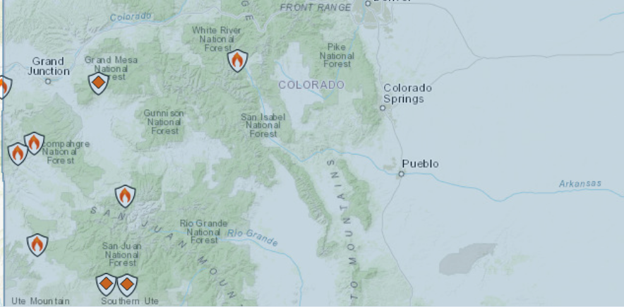
The Pueblo wildfire grew from 40 acres to 30 thousand acres in one day at the same time fire weather watches are up and winds are howling throughout the state. Two fires start near Campgrounds/lakes and yet the fire chiefs proclaim they have no idea how the fires started! What steps must you take now if you own property in Colorado? What really happens if your property is impacted by a fire and how do you avoid a huge mistake one of our borrowers made that cost him everything? What are the best sites to see the active wildfires and air quality in Colorado?
As the summer temperatures climb wildfire season has begun to flare up throughout the country with active fires in NM, CA, CO and others. Living and working in the Colorado mountains, I’ve unfortunately had the experience of seeing a wildfire off the deck of my house and being evacuated with moments to spare (see prior blog post). Last summer we had two loans in Colorado that were impacted by a major wildfire and were totally lost as a result. Fortunately all that was lost was property and the owners got out safely. The experience turned into a financial disaster for one borrower while the other was fine financially; learn why and how to avoid the same mistakes.
Why is wildfire risk increasing in Colorado
You aren’t just imagining it, wildfire risk is increasing in Colorado. Although our politicians opine that it is all because of climate change, the real increases recently in Colorado wildfire risk are human linked. Here are the top four reasons for increasing wildfire risk.
- Human causes: Humans cause roughly 85% to 90% of all wildfires in the United States, according to the S. National Park Service and the National Interagency Fire Center
- Lack of fire bans: even with the knowledge that humans cause 90% of wildfires, every county is extremely late to put in fire bans. Essentially they wait to put in a fire ban until certain dryness conditions are met. For example in Pueblo, after the major wildfire started the fire chief said they would immediately go to stage 2 fire ban which prohibits all campfires Why wait. As I’m writing this article there were three active fires, red flag warnings, and fire weather watches. Why are counties not proactive in putting in a fire ban?
- Building in high risk areas: Along with increasing probabilities of fire starts due to humans, we continue to build in extremely high risk areas. I recently saw a full log house built up a drainage area with hundreds of beetle kill trees around. It is absolutely impossible to prevent that house from burning in a wildfire.
- Building non fire resistant houses: In Colorado we are still allowing a log home with wood shingle roofs to be built. Why? There is absolutely no way to prevent that house from burning even in a small wildfire but still counties allow wood siding, wood fences touching houses, etc… that radically increase the risk of loss.
- Tourism: As tourism in Colorado increases, so does the risk of fires. It is a probability game, the more people, the higher the probability of one bad apple leaving a campfire unattended, shooting in dry grass, shooting off fireworks, etc…
Based on the risks above, unfortunately almost every property in the state is more at risk from wildfires from the front range to the western slope risk is increasing.
5 tips for every property owner to help ensure you don’t lose everything in a Colorado Wildfire
So what really happens after the embers have cooled and there is a loss? How does the lender factor into the payout? Are you prepared if this were to happen to you?
In a major wildfire in Colorado we had a total loss on a property in the black forest area of Colorado. We had made a 90k loan on a small cabin. The borrower insured the property to 90k even though I told him that the rebuild cost was substantially more. To save money, the borrower opted for bare minimum insurance. One would assume everything should be okay until there was a major fire that burned multiple houses in the area including his and he lost everything. To protect yourself against the same outcome, it is important that you take steps now?
- Are you properly insured? In the last major wildfire in Colorado, the insurance group in Colorado found that 80% of homeowners who filed a claim were not fully insured. Most people insured their house when they bought the property and have not revisited their coverage to take into account changes in the market, improvements to the house, etc… I wrote a prior blog to help guide you through this process: Are you properly insured? Tax value, market value, replacement cost what is the difference
- What happens after the loss? After the loss a claim is filed by the borrower. The insurance adjuster comes out to survey the damage and goes through a worksheet on the loss. If the house is a total loss (in our case we had a loan on a property in black forest Colorado where nothing was left), they determine the claim amount; this amount is capped by your policy. For example in our case, the insurance company paid out 90k (see below on how this is paid out). Unfortunately this was a financial disaster for the borrower since the rebuild cost to bring the property up to current codes was almost 200k.
- What does your mortgage company have to do with the claim? When a borrower receives a mortgage on a property, the mortgage company to secure their interest is added as an additional insured. So any loss is typically paid out jointly to the insurance company and the mortgage company. In the case above the borrower did not have the additional 110k in funds to rebuild the property; the 90k came to us as the lender and the loan was paid off. Also it is important to read your loan documents to see what the lender will do in a total loss situation, there are some lenders that will demand a full payoff of their mortgage.
- What happened to our borrower? Due to the borrower being underinsured, he successfully lost all of his equity in the house. The borrower was left with a vacant lot that was not very desirable and of little value for at least 10 years until thing regrew in the area. When we closed the loan the property was worth around 350k an all of this was eliminated during the fire due to underinsurance
- How can you avoid the same situation? Being underinsured can easily occur, markets can change rapidly and also improvements to the property are made. After going through the experience with our borrower, I took three steps to ensure I was properly insured.
- I got a worksheet from my agent and I went room by room detailing the finishes in each room; for example we have hardwoods throughout the house along with new cabinets, fireplace, etc… none of this was factored into the prior rebuild cost. In my case after going through the exercise our rebuild cost was double what the insurance agency had originally suggested. I therefore increased my coverage for the higher rebuild costs
- Get an appraisal, if there is a total loss and you decide not to rebuild (or are not allowed to rebuild as in the case of some wildfires where the area is deemed too high risk, etc..). An appraisal will help you reach a settlement with the insurance company since you have a before snapshot of value (I got a copy of an appraisal a couple years ago when I refinanced the house
- Document your belongings: I took my phone, walked around the house and talked about each room (example hardwood floors, rock fireplace, new windows, china cabinet, etc…) so you at least have some inventory of the household goods part (I know that you “should” do a whole house inventory but who is going to go through and count the number of shirts they have, forks, etc… just not practical in my mind)
Do not underestimate rebuild cost after a Colorado Wildfire
Inflation has increased in the last 6 years along with everything housing related. It is now substantially more expensive to build as material costs have increased substantially along with labor costs. Many insurance models have not kept pace with the huge jumps in rebuilding costs. As a property owner, the onus is on you to ensure your property is adequately insured. On every one of my properties the structure was underinsured when I reviewed them a few years ago. My primary was about 40% underinsured as build costs have increased exponentially in the mountains.
What happens when you are underinsured in Colorado?
Being underinsured means your policy limits fall short of the actual cost to repair or rebuild your home after a disaster. If a claim occurs, you will face significant out-of-pocket expenses, delays in rebuilding, and potentially insufficient funds to secure temporary housing.
The financial risks of underinsurance are huge and could ruin many homeowners:
- Massive Out-of-Pocket Gaps: If rebuilding costs $800,000 but your dwelling limit is capped at $400,000, you are personally responsible for the remaining $400,000, plus your deductible.
- The Co-Insurance Penalty: Many policies enforce the “80% rule”. If your home is insured for less than 80% of its total replacement cost, the insurer may prorate your payout, forcing you to pay an even larger share of the damages. I’ve started seeing this language in most residential policies so ensure you check your specific policy.
- Exhausted Living Expenses: Coverage for “loss of use” (temporary housing and meals while your home is repaired) usually has a strict dollar limit or time limit. If rebuilding drags on, you may have to cover rent out of your own pocket. Think of any fire in Colorado, rebuilding could take years as there are not enough workers to quickly rebuild. We have seen this in every single fire recently in Colorado.
- Depreciated Personal Property: If you haven’t documented your belongings, your payout for furniture and electronics might be based on their current depreciated (used) value rather than what it costs to buy them new.
- You are still liable for the mortgage: Even if your house burns, you are still liable for your mortgage payments each month along with tax and insurance payments. This can be a huge financial burden especially if you are paying out of pocket to live somewhere else.

What are the best sites to see the active wildfires and air quality in Colorado?
My two go to sites for wildfire information and air quality:
- Inciweb: this the is the official government site, you can click on a fire and get details
- Airnow: You can see air quality and where the smoke plumes are heading. Also zoom in on a fire and you can see how active it is and where the spot fires are heading.
Fire Risk in Colorado continues to increase make sure you are ready
Although our politicians want to blame everything on climate change and all these factors we can’t control, unfortunately this cannot be further from the truth. The real cause of increasing fire danger in Colorado is human caused whether it is humans causing the blaze, building where they shouldn’t build, building structures that are not fire resistant at all, or local governments not enacting fire bans until something catches on fire. All these factors are increasing risks for every property owner throughout Colorado and if you own property you must take action now.
Before the first embers you need to ensure you are properly insured at replacement cost so that you are not left with a huge problem if there is a fire. Also, document the condition of your property and belonging so at least you have proof if you must file a claim with the insurance company.
If you decide not to act, you likely could end up like our borrower in Black Forest that lost not only their house, but also all their equity that was wiped out due to the fire. Make sure you understand the risk of underinsurance and are willing to take that risk in the event of a loss.
Other Resources for Colorado Wildfire information
Wildfire season are you prepared: 5 tips to take now to ensure you and your families safety
Are you properly insured? Tax value, market value, replacement cost what is the difference
https://www.nps.gov/articles/wildfire-causes-and-evaluation.htm
We are a Colorado Private/ Hard Money Lender funding in cash!
If you were forwarded this message, please subscribe to our newsletter
I need your help as my goal in writing these articles is to provide the best information/insight on Colorado Real Estate that you cannot get anywhere else! Please like and share my articles on linked in, twitter, facebook, and other social media and forward to your friends/associates 😊 I would greatly appreciate it.
Glen Weinberg personally writes these weekly real estate blogs based on his real estate experience as a lender and property owner. He is the owner of Fairview Commercial Lending. Glen has been published as an expert in hard money lending, real estate valuation, financing, and various other real estate topics in Bloomberg, Businessweek ,the Colorado Real Estate Journal, National Association of Realtors Magazine, The Real Deal real estate news, the CO Biz Magazine, The Denver Post, The Scotsman mortgage broker guide, Mortgage Professional America and various other national publications.
Glen resides in Colorado, lends in Colorado, owns property in Colorado, and services loans in Colorado which provides a unique real estate prospective of what is actually happening on the ground both in Denver and throughout Colorado. My goal of this real estate blog is to provide an honest assessment of what I see happening in Colorado real estate and how it will impact real estate owners, buyers, realtors, mortgage professionals, etc…
Fairview is the recognized leader in Colorado Hard Money and Colorado private lending focusing on residential investment properties and commercial properties both in Denver and throughout the state. We are the Colorado experts having closed thousands of loans throughout the Front range, Western slope, resort communities, and everywhere in between. We also live, work, and play in the mountains throughout Colorado and understand the intricacies of each market.
When you call you will speak directly to the decision makers and get an honest answer quickly. We are recognized in the industry as the leader in Colorado hard money lending with no upfront fees or any other games. Learn more about Hard Money Lending through our free Hard Money Guide. To get started on a loan all we need is our simple one page application (no upfront fees or other games). Learn how to find a reputable hard money lender and why Fairview is the best hard money lender for investors.
Tags: Denver hard money, Denver Colorado hard money lender, Colorado hard money, Colorado private lender, Denver private lender, Colorado ski lender, Colorado real estate trends, Colorado real estate prices, Private real estate loans, Hard money loans, Private real estate mortgage, Hard money mortgage lender, Hard money mortgage lender, residential hard money loans, commercial hard money loans, private mortgage lender, Hard Money Lender, Private lender, private real estate lender, residential hard money lender, commercial hard money lender, No doc real estate lender